> For the complete documentation index, see [llms.txt](https://docs.aarna.ai/llms.txt). Markdown versions of documentation pages are available by appending `.md` to page URLs; this page is available as [Markdown](https://docs.aarna.ai/vaults/base/atvusdc-base.md).
# âtvUSDC - Base
on-chain yield aggregator
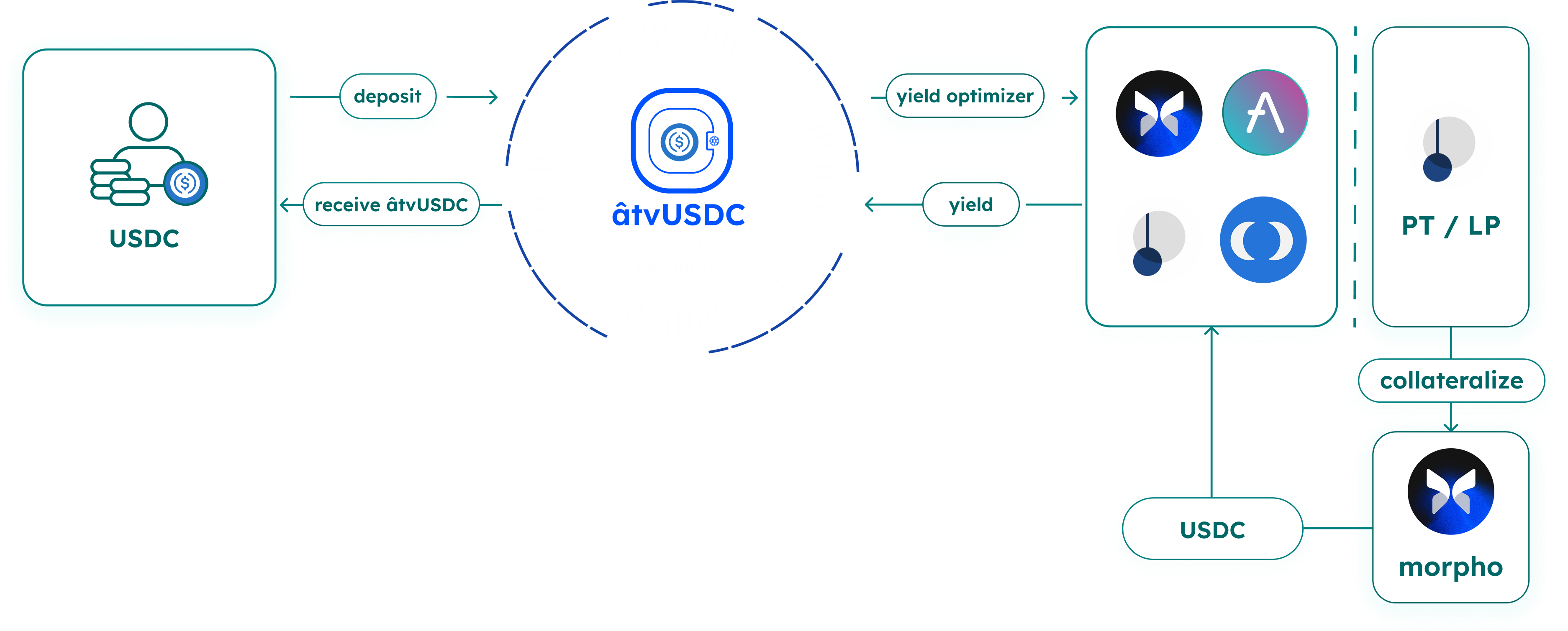
âtvUSDC on Base is a USDC vault that routes into blue-chip venues Aave, Moonwell, Morpho, and Pendle (PT/LP) to stack base lending yield with basis capture when spreads are attractive. When carry is clearly positive, the vault may run a bounded single-collateral loop on Morpho to lift net returns, with all accrual reflected directly in on-chain NAV. Holders are eligible for native $AARNA emissions, adding a second APY layer; in normal markets this targets a \~8-12% band on USDC. Outcome: one composable token, policy-driven execution, and clean accounting without degen pyramids.
#### Yield rate stack: Example
Unlevered USDC lending
* Morpho: \~8.09%
* Moonwell: \~6.60%
* Aave: \~3.80%
* Pendle (unlevered PT/LP): \~10%
These legs provide a clean base yield profile on USDC without introducing leverage.
Looped PT carry using USDC
* USDC is first deployed into PTUSDe at an effective base yield of \~5.12% APY.
* PTUSDe is then supplied as collateral on Morpho, targeting \~70% LTV, with a USDC borrow rate of \~7.5%.
* Borrowed USDC is recycled back into PT positions with an illustrative PT APY of \~10%, creating a single conservative loop.
* Incremental funding cost on borrowed USDC: 0.7 × 7.5% ≈ 5.25%
* Incremental levered PT yield on borrowed notional: 0.7 × 10% ≈ 7.0%
* Net looped APY:5.12% − 5.25% + 7.0% ≈ 6.9%
The vault does not sit in a single loop or market. âTARS, aarnâ’s agentic layer, continuously scans lending rates, PT yields, liquidity, tenors, and oracle-parity bands, and aggregates between unlevered lending and PT loops so that âtvUSDC aggregates towards the best available net USDC yield within predefined guardrails. LTV caps, pool allowlists, depth thresholds, and expiry windows are all enforced at the vault level.
Compared with leaving USDC idle or in a single money market, âtvUSDC adds a structured carry layer on top of base stablecoin exposure. The PT loop is calibrated to lift illustrative yield by roughly 15-30% versus unlevered PTs using a capped-LTV loop, while âTARS handles rate checks, routing, and unwinds.